How Much Does It Actually Cost to Find Distributors?
What it costs to find a distributor mostly comes down to two things: how many companies in your market could realistically distribute your product, and how much one of them would be worth to you once they're selling. The invoice is only part of it. You also pay with your team's time and with months on the calendar, and some routes leave you with something you can use again while others leave you with nothing. If you know roughly how many partners are out there and what one is worth, you can work out what you can afford to spend finding one.
Say your sales director comes back from a planning meeting and the company has booked next year's big trade fair. The organiser quoted €10,000 for the space, and nobody really questioned it, because the company has been going to that fair for years and it's kind of what you do.
But nobody asked how many distributors who could actually sell your product will be walking around those halls, or whether you could have talked to the same companies before spending anything. And by the way, the €10,000 is only the start of the bill.
The fair might be the right call. I'd just want the full cost on the table before anyone signs, next to what the other routes from How Do Manufacturers Find Distributors? Five Routes to Market would cost for the same market.
Stand space is about a fifth of a trade show bill
The most detailed numbers I've found on this come from Germany. The ifo Institute did a study for AUMA, the German trade fair association, on what exhibitors actually spend. Stand rent plus basic charges like electricity was 21.2% of the total. Building the stand was 30.3%, internal staff 15.6%, hotels and food 13.5% and travel 9.9%. The average exhibitor spent €28,400 per fair, and that was 2014 to 2017 data, so I'd expect it to be higher today.
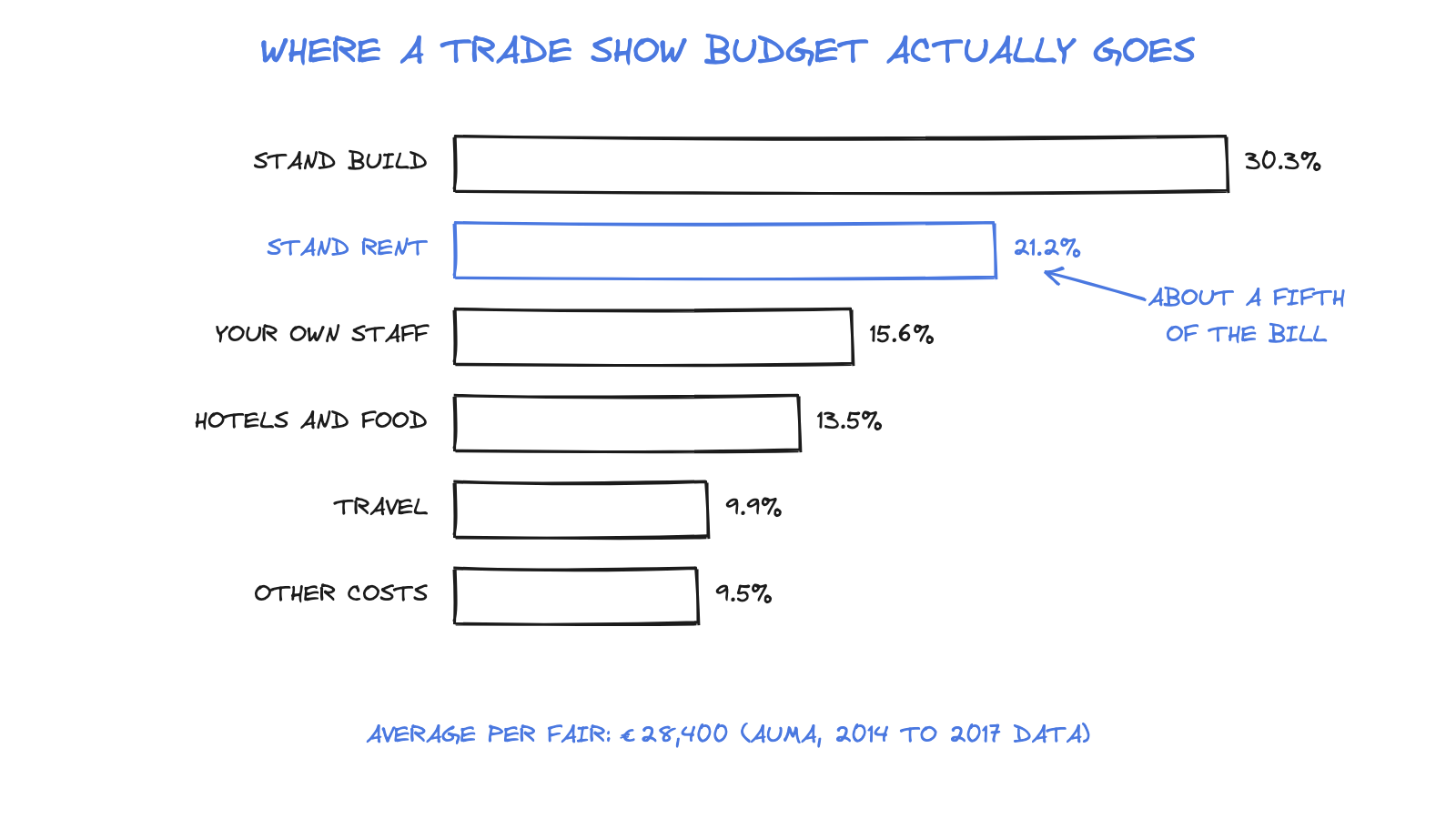
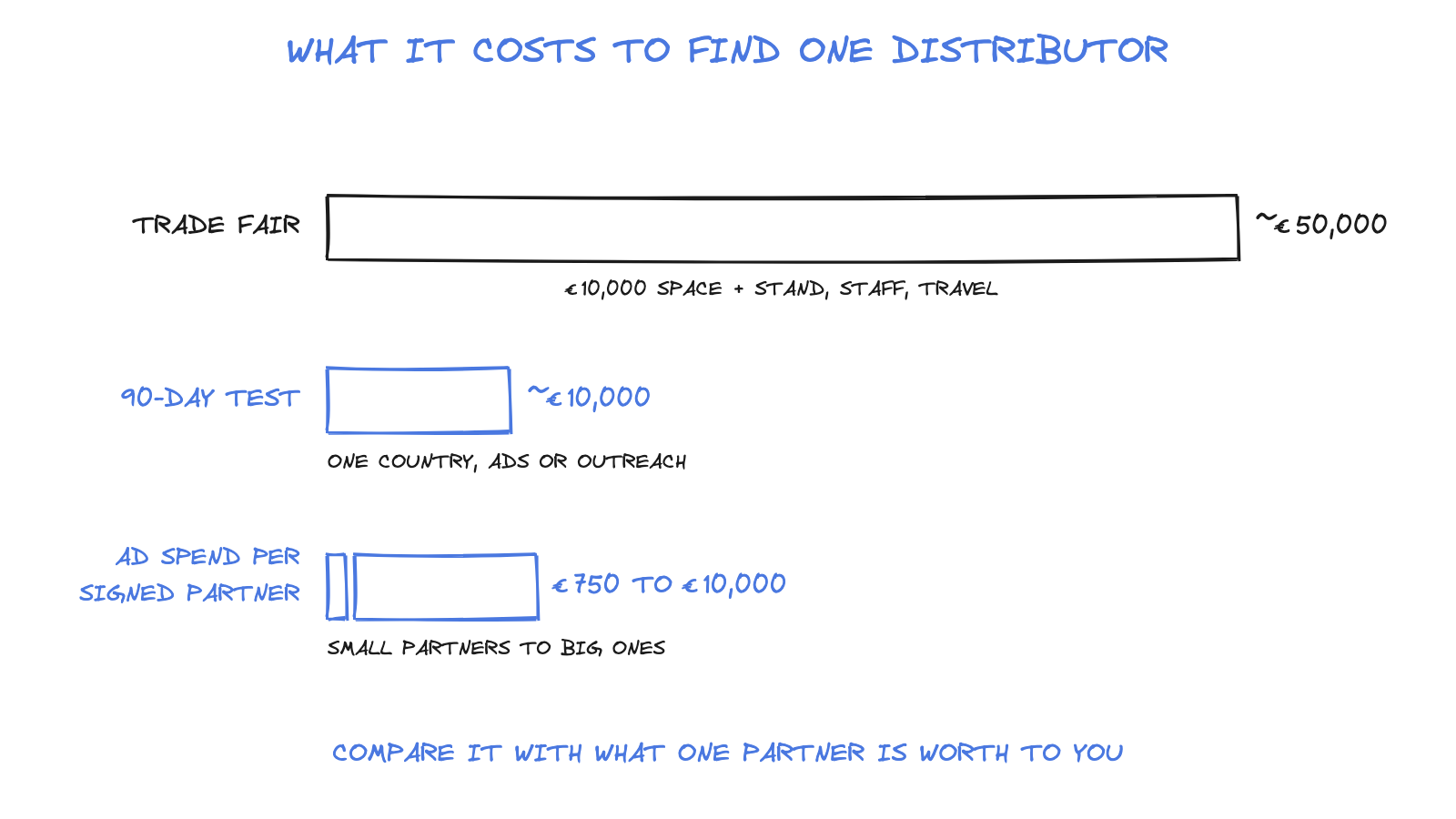
So if the organiser quotes €10,000 for the space, the whole fair will probably cost you somewhere around €50,000 once you add the stand build and your team's week away.
If you'd rather reach those companies without a stand, I covered how in How to Find Distributors in a New Market Without Trade Shows.
A fair also has a fixed date. If the next one is in eight months, you wait eight months before you speak with anyone, and in the meantime a competitor might sign the distributor you wanted.
So in the table below, next to what each route costs, I've added two things a price list leaves out: how long until you learn something useful, and what you still have if nobody signs.
Route | What you pay | Time to the first useful signal | What you keep if no one signs |
|---|---|---|---|
Exhibiting at a trade show | Space, stand build, staff, travel and hotels. Stand rent is about a fifth of the total | Whenever the next edition is, often months away | Contacts and badge scans, which go cold quickly without follow-up |
Visiting a show with pre-booked meetings | Travel and hotel, plus the time it takes to book the meetings | The show date, but the meetings are already qualified | Conversations with companies you picked, plus what you learned while booking them |
Direct outbound | Data tools or research, plus your team's time for outreach and follow-up | Usually a few weeks after the first messages go out | A verified list of the relevant companies in that market and what each one carries, plus the objections you heard |
Paid ads | Ad spend and the landing page, plus time to qualify enquiries | A few weeks after launch, if the market is big enough | The enquiries, and data on which messages got the right companies to respond |
Government or chamber partner searches | A service fee, which depends on the country and whether you qualify | Depends on the organisation, so ask before you pay | A handful of names or meetings, depending on the service |
If I were the CFO, I'd look at the last column first. If a fair goes badly, you've spent the budget and come home with a box of business cards. If an outbound test goes badly, you still have a list of the relevant distributors in that country and the reasons the ones you spoke with said no. When you try again in six months with a different offer, you can start with the companies that said "not now" instead of researching the market again.
Count the distributors before you choose the channel
Before you decide how to reach distributors, find out roughly how many there are, because the answer changes which channel you can afford.
Some markets are a lot smaller than people expect. Eurostat publishes the number of wholesale businesses in each category. In 2023 it counted 155 companies wholesaling textile machinery in Germany, 41 in the Netherlands and 12 in Austria. For machine tools it was 59 in Croatia and 149 in Austria. Germany alone also had more than 13,000 companies wholesaling "other machinery and equipment".
Those categories won't match your product exactly, and a lot of the companies in them wouldn't be a fit anyway. Depending on what you sell, you might have a few dozen possible partners in a country or a few thousand, and you'd approach those two markets very differently.
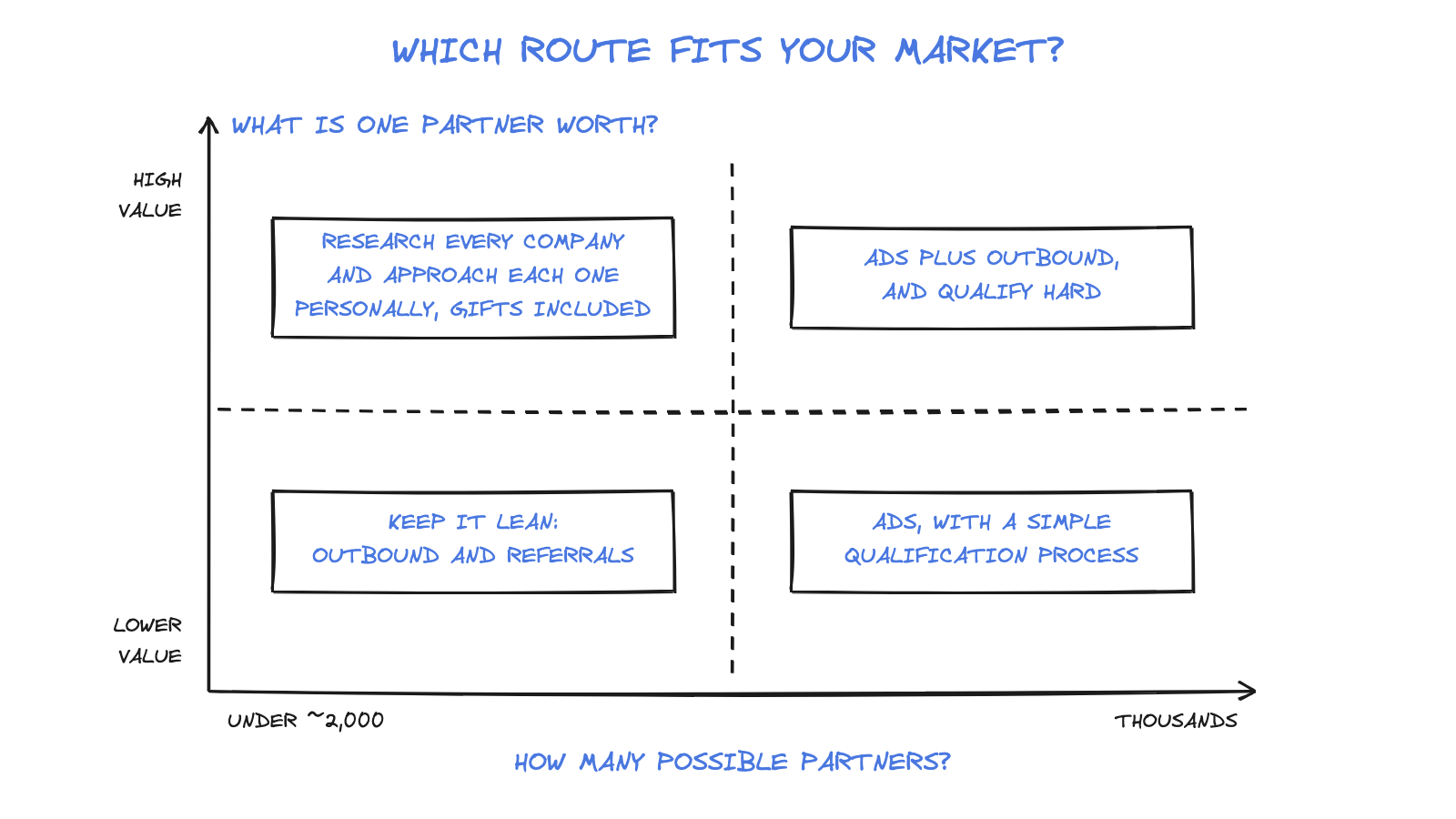
When we plan a campaign, for high-volume outbound we usually want at least 2,000 companies in the market that could buy from them, because volume outreach gets through a list quickly. Ads need a decent pool too, at least 1,000. When a niche only has 100 to 500 real distributors, we switch to researched, account-by-account outreach instead of volume.
With 3,000 salons or garden centres, ads make a lot of sense. Researching each one by hand gets expensive per conversation, and ads let the interested ones come to you. As I said in Five Routes, that also puts you in a better position, because they reached out first.
If there are only 150 of them, I'd still contact them one by one, but I'd put a lot more thought into each approach, because with a list that short, a generic email just burns through it. This is where you can get creative. I know someone who sent a few jars of honey to 60 companies they wanted to work with. Each jar had a QR code that took the person to a landing page about their company's specific problems and how they'd approach them, and they got about 10 meetings out of those 60 companies. A company from Monaco I know sent letters to its target list offering the recipient a bottle of champagne and a tin of caviar if they agreed to a meeting.
Say each gift and the research behind it costs you €100 per company. For 150 companies that's €15,000, which is still well under the €50,000 fair from the start of this article.
To get a rough count, go on a database like Apollo.io and search for the type of company you want in that country. It won't be exact, but it tells you whether you're looking at a few hundred companies or a few thousand, and that's usually enough to decide.
Work backwards from what one distributor is worth
Once you know how big the market is, work out what a good distributor is worth to you, because that tells you how much you can spend finding one.
Let me give you a hypothetical example. Say one active distributor in Germany brings you about €40,000 a year in gross profit, between the opening order and the reorders after it. If they stay with you for three years, that's €120,000.
Now say a 90-day test in Germany costs you around €10,000 in outside spend, meaning the outreach build or the ad budget depending on the size of partner you're after. Your own team's time following up comes on top. If you get one good distributor out of it, you've spent a quarter of their first year's gross profit to find them. If you put €50,000 into a fair and nobody signs, you have nothing to show for it.
I made those numbers up, so put in your own margin and reorders. €10,000 only means something next to what one partner is worth to you.
The real numbers we see in our campaigns depend a lot on the size of the distributor you're after. With smaller distributors, a lead from ads costs us around €30 and about one in five qualifies, so a qualified lead comes to around €150. It takes 5 to 7 of those to sign one, which is roughly €750 to €1,050 in ad spend per distributor.
With a bigger company, say one doing €5 million a year that you'd expect to order at least €100,000 a year from you, a qualified lead costs more like €500 to €1,000, and our clients usually close somewhere between 10 and 20% of them. That puts you at roughly €2,500 to €10,000 in ad spend for each one you sign. Some clients close as few as 5%, and then it can go higher, but that's the exception. Next to €100,000 a year in orders, even €10,000 is small.
Outbound at volume works differently. About one in every 100 companies we contact turns into an interested lead, and it takes 5 to 7 of those to sign one distributor, so you're contacting 500 to 700 companies per partner. In a market with 150 possible partners, you can't get there on volume, which is why every approach in a small market has to count.
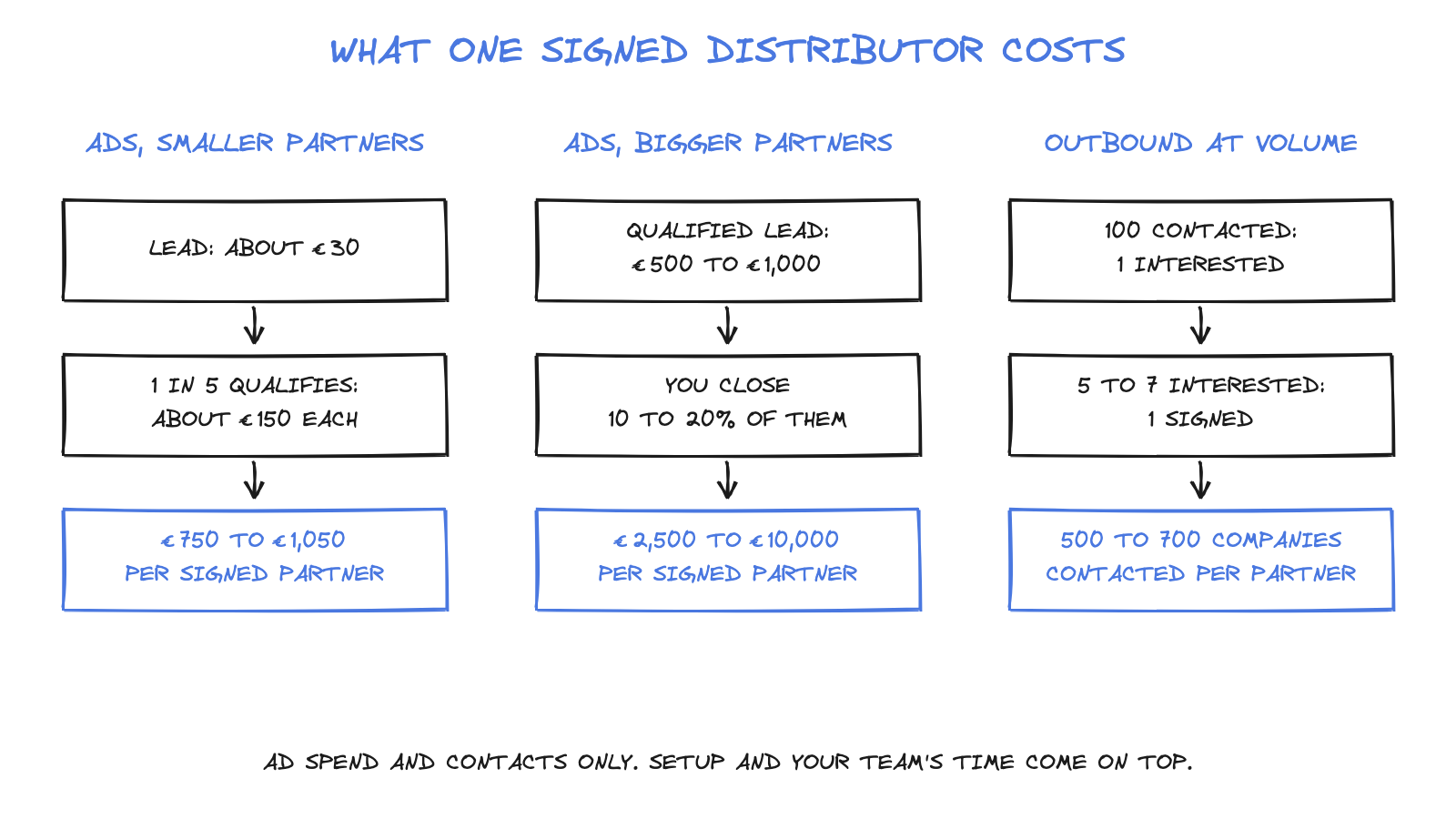
All of those figures are ad spend or contacts only. Add setup fees and your team's time on calls on top.
And this is where a lot of companies get stuck. I speak with manufacturers whose distributors could be worth millions to them over the years, and they still freeze when the budget to find one goes past a few thousand euros. I get it. For a private person or a very small business, that's a lot of money. But if you're a manufacturer, you have to look at it relative to what the partner could bring in. You can't expect a 300x return on what it costs to acquire a distributor. That isn't realistic in manufacturing, or in most industries, and if you hold out for it, you'll never spend enough to find anyone worth having.
José Mourinho said something in his Netflix documentary that I keep coming back to. A producer asked him why he hadn't been able to repeat his Champions League wins, and his answer was:
"In every situation, there is objectives in relation to the potential. These objectives, I promise you I reach them. Small miracles. But the big ones? Jesus Christ."
I like that because it works both ways. Don't underspend on something with real potential, and don't expect a miracle bigger than the potential either. If you buy a list from Apollo, message three people on LinkedIn and expect a €300,000 deal as a company doing €100,000 a year, you're asking for the big miracle. It doesn't work like that. If you contact enough companies for long enough, your acquisition cost will settle at whatever is normal for your industry. The job is to make sure the result is in proportion to the potential and that you're willing to invest what that takes.
One more thing people forget is that finding a distributor and launching with them are two different bills. Once someone says yes, you still have samples, display units, freight and training their salespeople, and you'll probably be on some of their first customer calls too. All of that sits outside your recruitment budget. It also affects whether the distributor can make money on your range at all, which I go through in Why a Good Product Can Be a Bad Business for a Distributor. So budget for both, otherwise a good partner can end up sitting on your samples for months without selling any.
The most expensive outcome, though, is signing the wrong distributor. If you go with whoever replied first and give them exclusivity, you can lose that market for two or three years, and that costs you far more than any recruitment budget. I wrote about how to check a partner before you commit in How to Evaluate a Distributor Before Giving Them Your Market.
What a 90-day test should get you
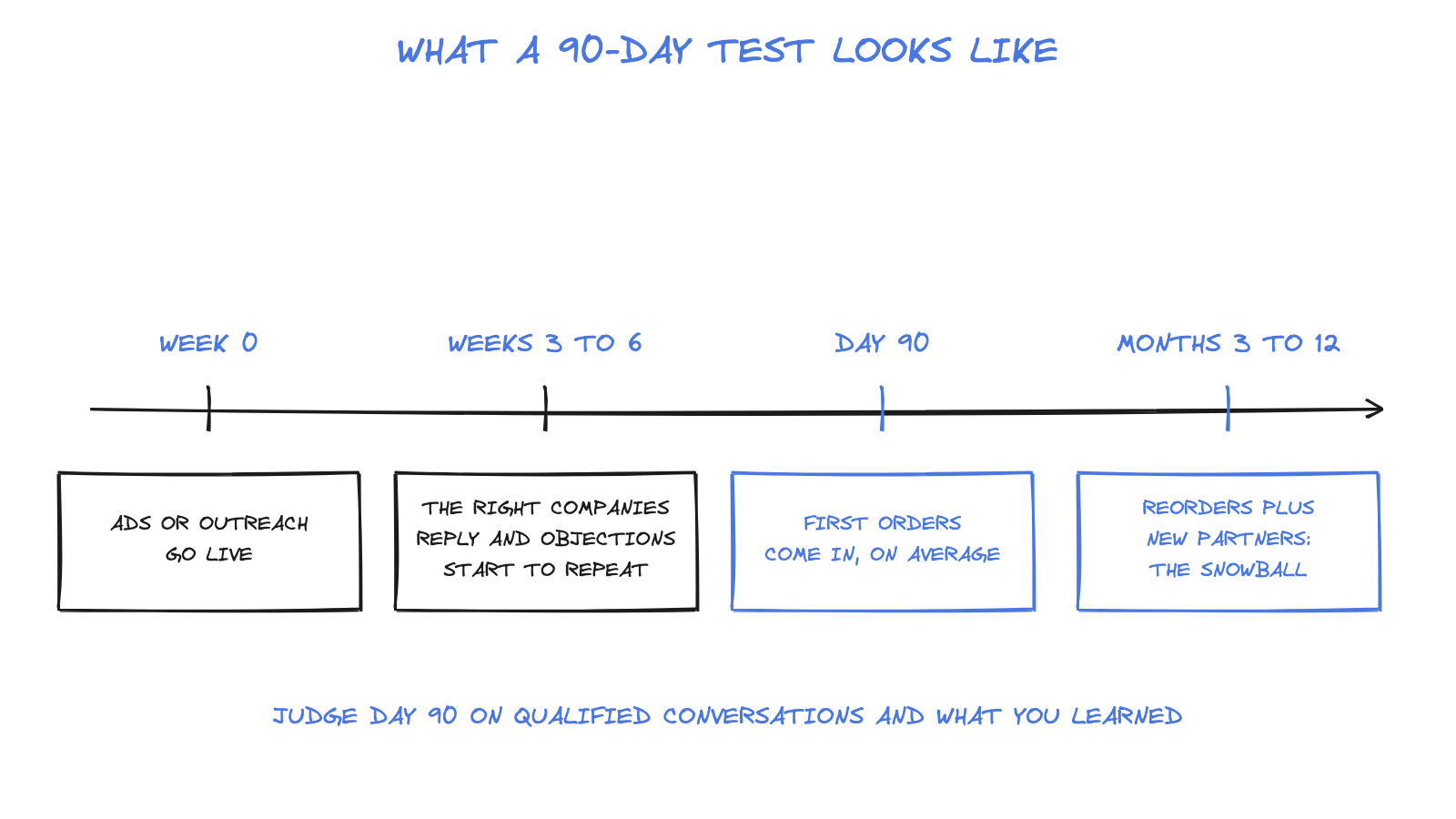
In 90 days you can learn a lot about a market. By the end you should know what the market looks like and have spoken with distributors who fit, and you should have a fair idea whether your offer makes commercial sense to them. If it's working, you usually notice within three to six weeks, because the right companies start replying and you keep hearing the same objections.
Some sales come in early, but on average the orders start coming in around month three, once distributors have tested samples and sold to their first customers. That's when it starts to snowball: the first partners reorder while new ones sign. So if you judge the test only on orders at day 90, you're judging it right when it's about to pick up.
Decide upfront what would make you keep going. Maybe it's a certain number of qualified conversations, or a few distributors testing samples. A clear reason the market isn't biting also counts. If good distributors keep telling you the margin doesn't work for them, you know what to fix in your offer, and you found out for a lot less than a fair would have cost you.
If you'd like help working out how many distributors your market actually has and what a sensible test would cost, tell us about your market and if it's a fit, we'll map it out together on a call.
Frequently asked questions
Why won't good agencies find distributors on commission only?
Because most of what decides whether a distributor deal closes is on the manufacturer's side: pricing, terms, whether the product is ready for that market and how the final negotiation goes. These deals also take months, and a lot of that time goes into educating the market. An agency working only on commission has to protect itself somehow, so it either goes after the two or three easy conversations and drops off when it gets hard, or it pushes any reseller who's willing to sign so it gets paid. Either way, the manufacturer ends up with no partner or the wrong one.
Are government export partner searches cheaper than outbound?
Per name, sometimes. The U.S. Commercial Service charges $2,500 for an International Partner Search, which gets you up to five companies that said they're interested, or $3,300 with virtual introductions. Its Gold Key Service is $3,250 for the standard package of arranged meetings. Only export-ready U.S. companies can use them, and travel is on you. You get five companies at most, on their timeline, and you still have to qualify them yourself. Outbound costs more upfront, but you see the whole market and pick who's worth talking to.
How much should you budget to test one country before booking a trade show?
Enough to run ads or outreach for about 90 days and follow up properly with whoever responds. As a rough guide, around €10,000 for one country in outside spend, either the outreach build or the ad budget depending on partner size, before your team's time on follow-up calls. With smaller partners, that covers the ad spend for several signings. With bigger ones, it's close to the top of what one signed partner costs in ad spend, and going above it is rare. Either way, it's well below what the average German fair cost exhibitors back in 2014 to 2017. Judge it on the qualified conversations and what you learned about the market. Orders usually start around month three.
About the author
Marijan Filipović is a founder and partner at Spika Solutions, where he helps manufacturers find and sign distributors in new markets. Spika has helped clients look for partners in more than 100 markets across 5 continents through paid ads and outbound.
Sources
AUMA Edition 49, ifo Institute study (exhibitor spending split and €28,400 average)
Eurostat, Enterprises by detailed NACE Rev. 2 activity, 2023
U.S. Commercial Service: International Partner Search and Gold Key Service