How to Structure an Opening Order a Distributor Will Actually Reorder From
The best opening order is the one a distributor can sell through in the first one to three months, so they come back and reorder. A big first order looks like a win on your side, but it often means the next order never comes, because the distributor is sitting on stock for a year. Size the first order to what they can realistically sell to customers they've already named, and tie better terms to the reorders instead of the first order.
Say a distributor in Poland likes your product and you're negotiating the first order. You push for 500 units, because that's what makes the shipment worth it and it's a nice number to report back. They agree, reluctantly. Twelve months later they've sold most of it, but they've never reordered, they've stopped mentioning your range to customers, and every call with them starts with how much stock they're still holding.
Nothing went wrong in that story, by the way. The product sold. The first order was just sized for your side of the deal instead of theirs.
Why a big first order often kills the second one
From the distributor's side, an opening order is money they pay before their customers have bought anything. In Why a Good Product Can Be a Bad Business for a Distributor I showed how a higher margin can still be the worse deal when it ties up more cash. The opening order is where that bites hardest.
When the first order is too big, three things tend to happen:
1. The cash is stuck in your product, so the distributor gets cautious about anything that adds to it, including your reorders.
2. Their salespeople can lose interest in a product they're already overstocked on, because there's no pressure to move it before the next order.
3. You lose one of the most useful signals you have, which is the reorder. A second order is a strong sign their customers are buying, though I'd still ask for actual sell-through figures.
Same sales, different first order
Let me give you a hypothetical example, so the numbers are made up but the arithmetic is real. A distributor buys your product at €50 a unit and sells it on at €80. They sell about 40 units a month to their customers.
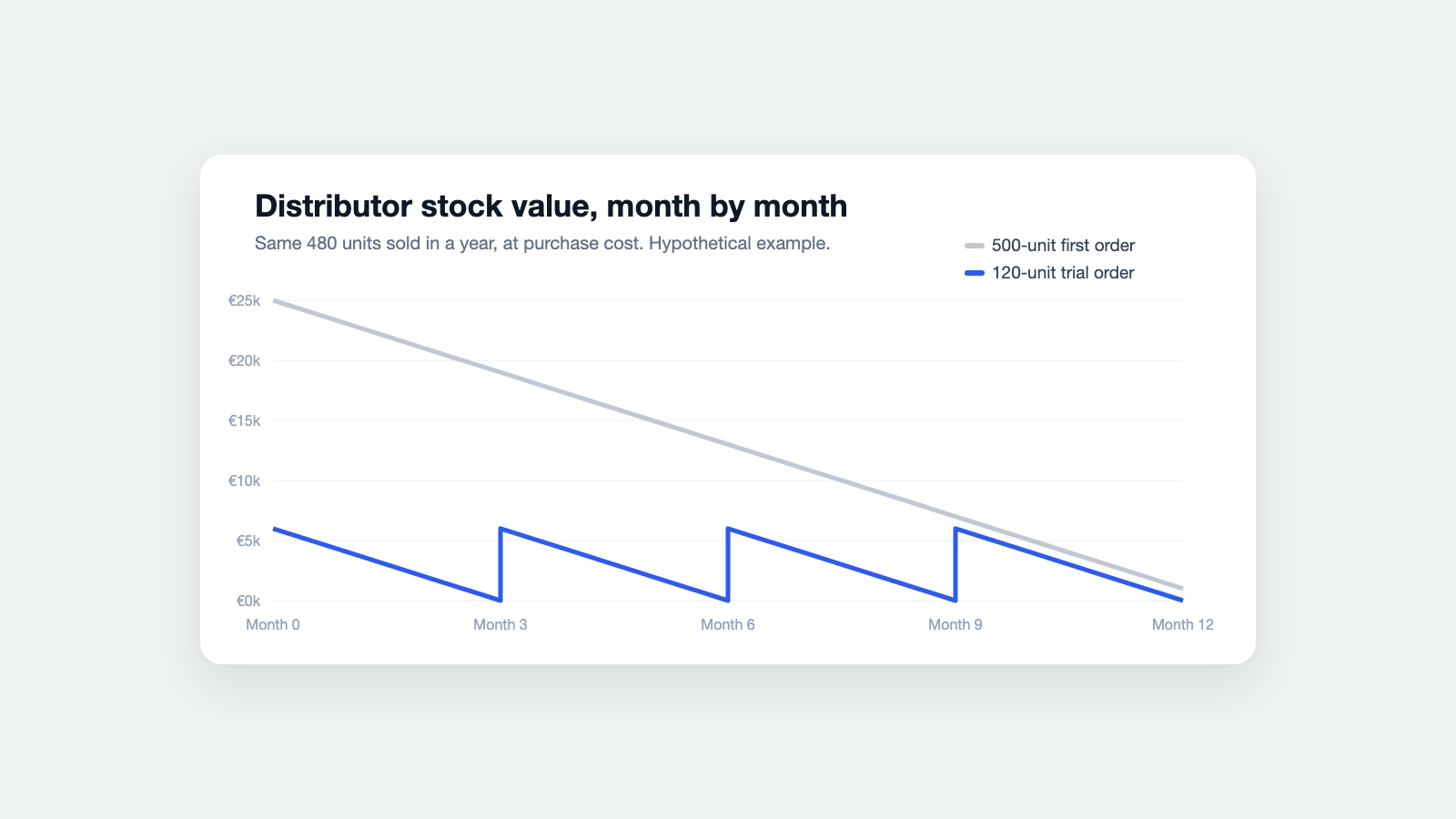
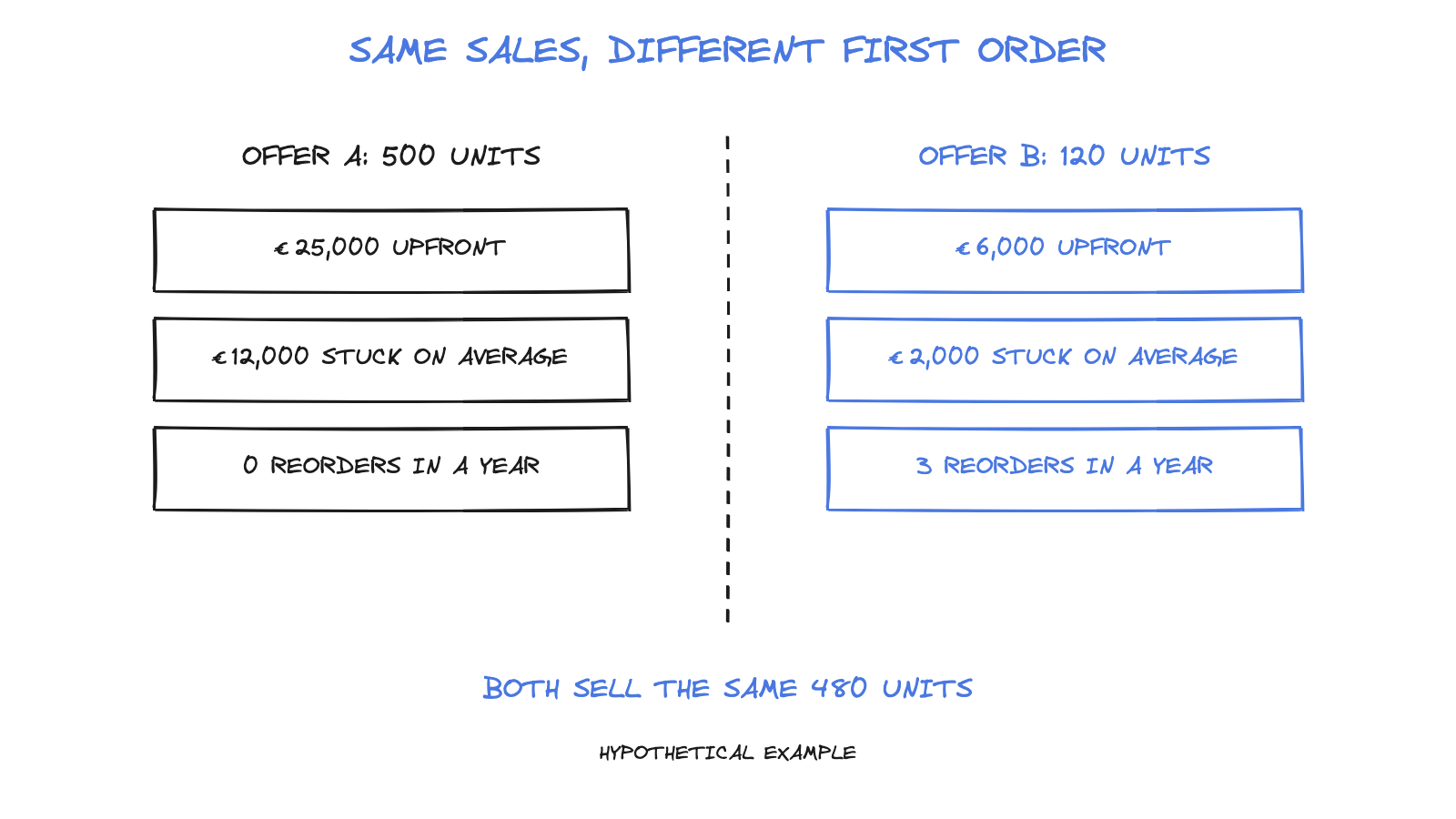
Offer A is a forced opening order of 500 units, €25,000 upfront. Offer B is a trial order of 120 units, €6,000, enough for about three months, with a 120-unit reorder each time they run out. To keep it simple, I'm assuming each reorder arrives right on time, at the start of months 4, 7 and 10, with no stockouts.
Selling 40 units a month | Offer A: 500 units | Offer B: 120 units |
First order | €25,000 | €6,000 |
Orders placed in 12 months | 1 | 4 |
Units sold to customers | 480 | 480 |
Average month-end distributor inventory, at purchase cost | €12,000 | €2,000 |
Manufacturer sales | €25,000 | €24,000 |
If it only sells 15 a month: inventory left at month 12 | €16,000 | €3,000 |
Illustrative arithmetic, not market data. Inventory is the average month-end stock the distributor holds, valued at their purchase cost. Reorders are assumed to arrive just in time with no stockouts. In the slower case, Offer B gets one 120-unit reorder at the start of month 9.
With the same sales, the distributor sells exactly the same 480 units in both cases and earns exactly the same margin. The difference is that with Offer B, their average month-end inventory of your product was about €2,000 at purchase cost instead of €12,000, and you got three reorders instead of none. Your sales as the manufacturer were almost the same too, €24,000 instead of €25,000, except they came as four orders with evidence behind each one.
Now look at the slower case, where it only sells 15 units a month. With Offer A, the distributor is left with €16,000 of your stock after a year and every reason to avoid you. With Offer B, after one reorder, they're holding €3,000. A sell-through review around day 60 would show you the slower pace in either case, but the smaller order limits how much is left sitting on their shelf while you work out what to do about it.
What this looks like with high-ticket equipment
The example above uses a product that sells by the box, but the same logic applies if you make machines that cost tens of thousands of euros. Let me give you another hypothetical. Say a distributor buys your machine at €20,000 and sells about one a month. Asking for an opening order of ten machines means €200,000 of their money sitting in a warehouse, and most equipment distributors either won't do it or will do it once and never again. A first order of one demo machine plus one or two in stock, around €40,000 to €60,000, lets them run demonstrations, sell the first units and reorder when a customer signs. With equipment, the demo unit often does more of the selling than the stock does, so I'd agree up front who pays for it and what happens to it after the first sales.
How to size the first order
Start from their customers, not your shipment. Ask the distributor which accounts they'd take it to first and how much each of those could realistically buy in the first couple of months. My starting point is an opening order that covers roughly the first 30 to 90 days of realistic sales to named customers. If they can't name any, that tells you something too, and I'd go back to How to Evaluate a Distributor Before Giving Them Your Market before arguing about quantities.
A few things make a smaller first order easier to agree on:
A mixed pallet with your three or four strongest products instead of a full container of one line.
For equipment, a demo unit plus one or two machines in stock instead of a full shipment.
A short list of SKUs aimed at the first use case, not the whole catalogue.
A clear lead time for reorders, so they know they won't run dry if it sells.
A review call booked around day 60 to look at what actually sold to customers, not just what they bought from you.
That last one matters, and so does agreeing a reorder trigger. When the stock they have on hand gets close to what they'd expect to sell during your replenishment lead time, plus a buffer you agree on, it's time to reorder, so nobody runs dry waiting for a shipment. In How Much Does It Actually Cost to Find Distributors? I explain that first orders usually come around month three and reorders build through the rest of the year. The review call is how you find out early whether you're on track.
Put the better terms on the reorders
The usual lever is a volume discount on the first order: buy 500 instead of 200 and get 10% off. I think that's usually the wrong lever for two reasons:
1. It rewards the distributor for buying more than they can sell, which is exactly the problem.
2. It lowers your price anchor and shows them you're willing to sell for less. Once you’ve discounted, it’s hard to get back to full price.
Tie the better terms to the second and third orders instead. For example, an extra few points of margin once they've reordered twice, or better payment terms on reorders. Then the reward comes when their customers have proven the product sells, and both of you want the same thing: more reorders.
The same logic applies to exclusivity. If a distributor wants it, I'd attach it to reorder or sell-through targets over an agreed period, not to the size of the first order. A big opening order buys you one shipment. A reorder target tells you whether they're actually building the market.
When your own minimum order gets in the way
Sometimes the problem is on your side. Your factory has a minimum production run, or freight only makes sense with a full container, so a small first order looks impossible.
There's usually a way around it. You can produce the run and hold part of the stock yourself, ship a mixed pallet with other products, use a consolidated shipment, or accept a slightly higher unit price on a small trial order and say clearly that the price drops on reorders. In most cases I'd avoid consignment to solve a factory minimum, where the distributor only pays for what sells. It leaves you carrying the inventory risk, and it tells you less about what the distributor is actually willing to commit.
If none of that works, the honest answer might be that this market or this partner is too small for your current setup, and it's better to know that before the first shipment than after.
What to agree before the first shipment
Before anything ships, I'd want these written down, even if it's just in an email:
The opening order, sized to named customers for the first 30 to 90 days.
The reorder lead time, the minimum reorder and the reorder trigger: stock on hand compared with expected sales during the lead time, plus a buffer.
What better terms they get on reorders, and when.
The date of the first review call, and what you'll look at on it.
Who does what in the first weeks: training, materials and joining the first customer visits, which I cover in Step 7 of How to Find Distributors in a New Market Without Trade Shows.
If you'd like help working out a first order a distributor in your market can say yes to, tell us about your market.
Frequently asked questions
How big should a distributor's opening order be?
As a starting point, roughly what they can sell to named customers in the first 30 to 90 days. That keeps their cash exposure low, gets you a reorder sooner and shows you early whether the product is moving.
Should you give distributors a volume discount on the first order?
Usually not. A discount for a bigger first order rewards them for buying more than they can sell and lowers your price anchor. Put the better terms on reorders instead, so the reward comes once their customers have bought.
What if my factory's minimum order is too big for a trial?
Hold part of the production run yourself, ship a mixed pallet or consolidate shipments, or charge a slightly higher unit price on the trial order that drops on reorders. I'd avoid consignment, because it leaves you carrying the inventory risk and tells you less about what the distributor is willing to commit.
About the author
Marijan Filipović is a co-founder at Spika, where he helps manufacturers find and sign international distributors. Spika has run distributor acquisition across more than 100 markets on 5 continents, combining direct outbound and inbound campaigns with the qualification and sales process required to move prospects from first conversation to a signed agreement.