How to Approach a Distributor About Carrying Your Product (And Get Them Off Email)
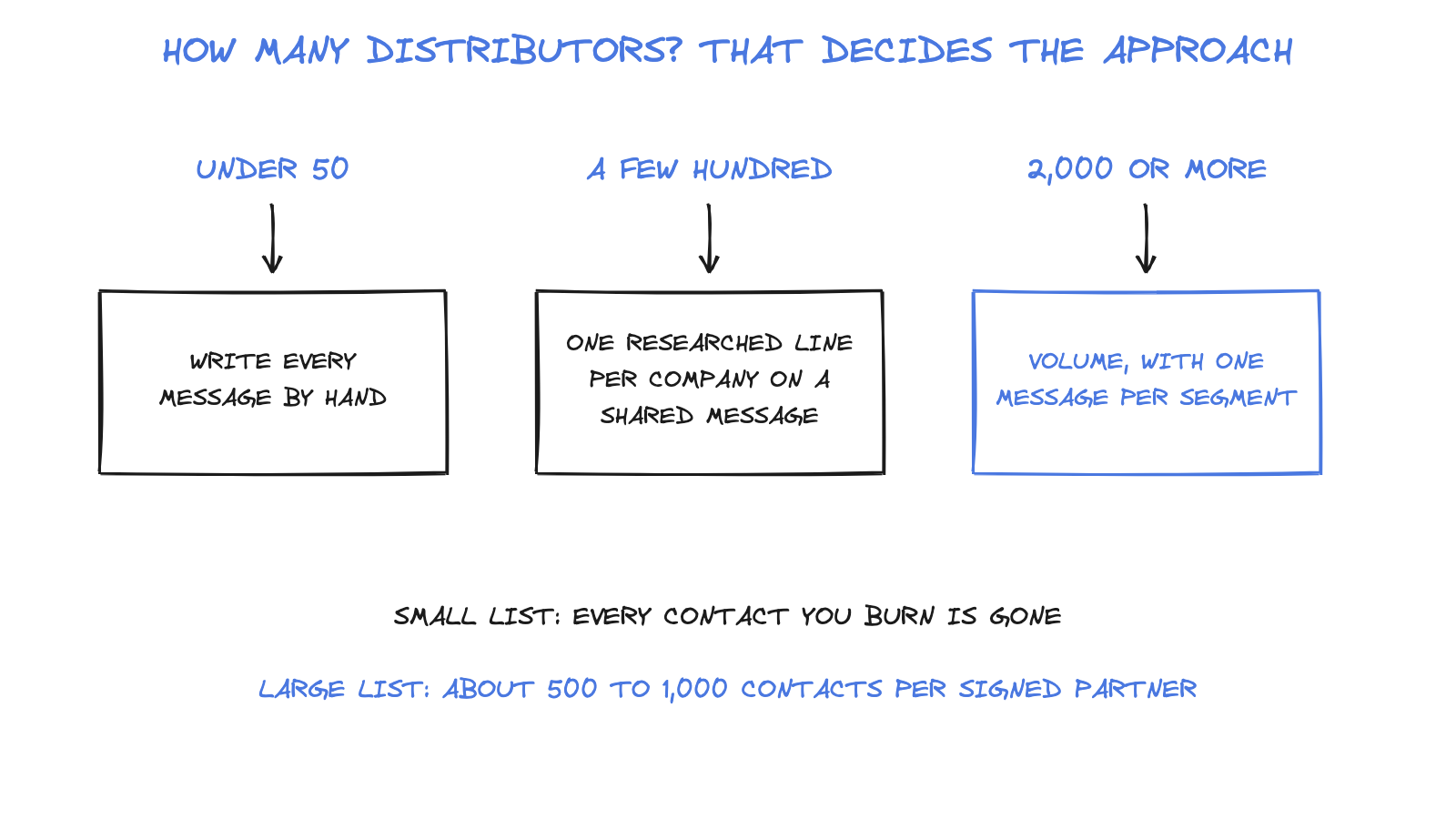
The way you approach a distributor depends mostly on how many of them could realistically sell your product. With a few hundred possible partners, every message has to be researched and personal, because a generic one burns through the list. With a few thousand, you can work at volume. Either way, the first message only has one job, which is to start a conversation, and the sooner that conversation moves off email and onto a call, the better your chances.
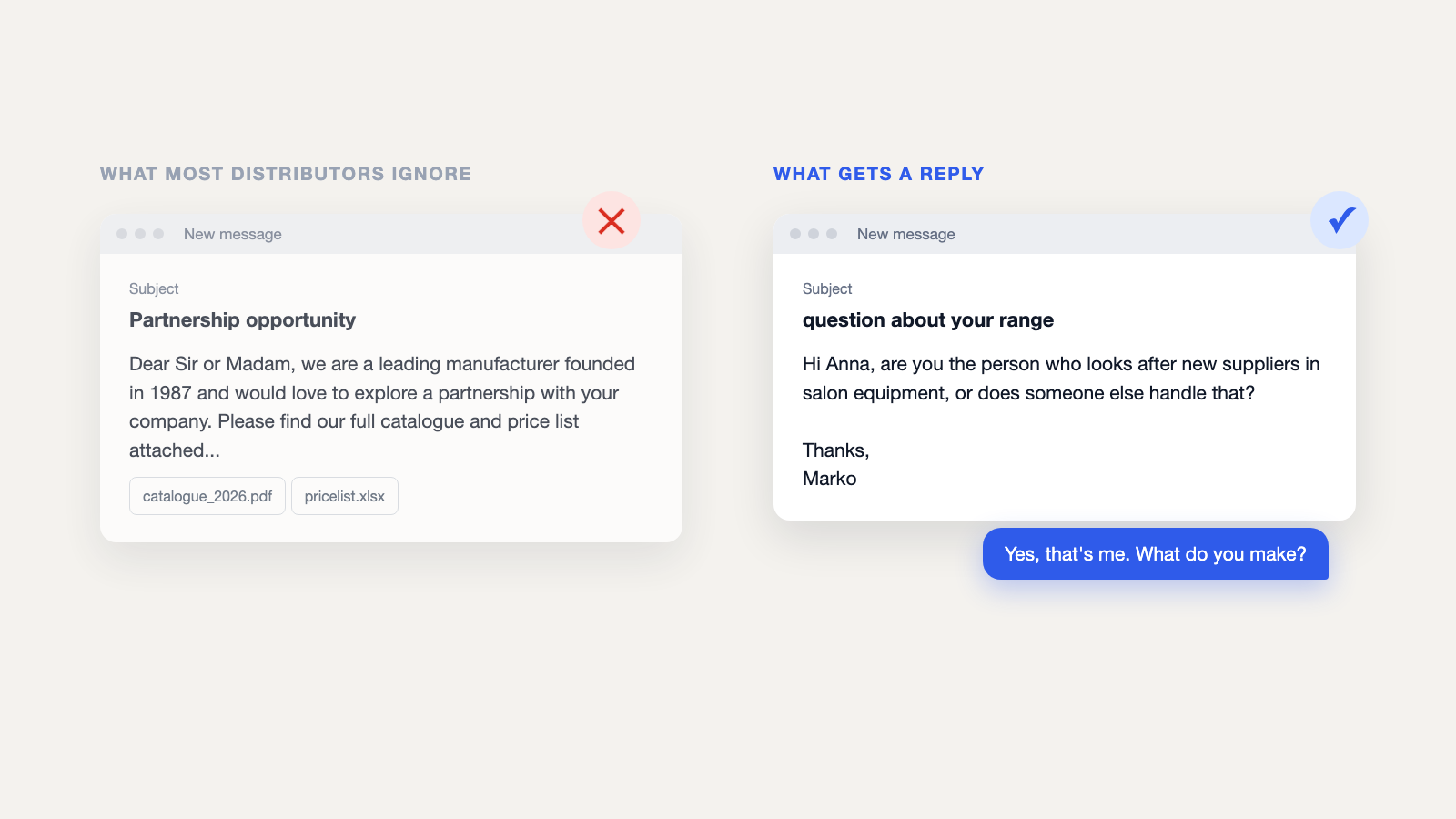
Say you've got a list of 40 distributors in Germany. You write one email, something like "We are a leading manufacturer of X, founded in 1987, and we'd love to explore a partnership. Please find our catalogue attached," and you send it to all 40. Two weeks later you've had one reply, and it's a no.
The usual conclusion is that outbound doesn't work in your industry. I'd say the email didn't work, and with only 40 companies on the list, you've just used up a good part of your market finding that out.
Your market size decides how you approach them
Before you write anything, know roughly how many companies could sell your product in that country. I go through how to count them in How Much Does It Actually Cost to Find Distributors?, and the number changes everything about how you will approach them.
With a market of 2,000 or more, you can send at volume. You segment the list, write a strong message per segment, add a researched line for each company and learn from the replies. From our numbers, about one in every 100 companies contacted turns into an interested lead, and it takes 5 to 10 of those to sign one distributor, so you're contacting 500 to 1,000 companies per partner. A big market can absorb that.
And those are companies, not people. We usually reach out to about three people in each company, like the owner, the purchasing manager and the category manager, instead of sending one email and hoping it lands with the right person. It's also the easiest way to make a list bigger without finding a single new company: you just reach more people in the companies you already have.
I know some of you are reading this and thinking, we can't email three people in the same company, that's too pushy. Fine. Then maybe you don't want distributors that badly, and that's okay. But this is what we do for every single one of our clients, because one person is on holiday, another is too busy to answer, and the third is often the one who actually decides. That's three chances at every company instead of one. In a small market it cuts the other way too: three people in each of 150 companies is 450 people reading your email, so it had better be a good one.
With 150 possible partners, you can't. At those rates, emailing all 150 gets you one or two interested leads and probably no signed partner. And you can't test your way to a better message either. You need thousands of sends just to prove that one email gets a 2% reply rate and another gets 1%, so in a 150-company market you run out of country before the test is finished. That means that in a small market, you research each company and get the message right the first time, because a contact you've burned is hard to get back.
Researching each company doesn't take long. Before you write, look at which brands they already carry, which tier of customer they sell to and where the gap is that your product could fill. That one gap becomes the first line of your message. With a short list you can also afford to get creative, like the honey jar campaign I described in the cost article, where a personal gift got about 10 meetings out of 60 companies.
Most markets sit somewhere in between. Into the hundreds, I'd write one researched line per company on top of a shared message. Under about 50, I'd write every message by hand.
The first message: ask for a pencil
Most first emails to distributors are entirely about the sender: who we are, how long we've been around, how big the factory is, and a catalogue attached. A quick test is to swap your company name for a competitor's. If the email still works, it's about you and not about them, and the distributor has no real reason to answer.
What I like to do instead is something I call the pencil effect. Think about first grade, when you were trying to make friends. You didn't walk up to another kid and ask whether they wanted to be your best friend for the rest of your lives. You asked to borrow a pencil or an eraser, something small and easy to say yes to, and the conversation started from there.
Email works the same way. Asking a distributor to consider a partnership in the first message is the best-friends-forever question. A small question they can answer in a few words is much easier to reply to. For example, and these are illustrations, not lines to copy:
"Are you the person who looks after new suppliers in {category}, or does someone else handle that?"
"Do your {customer type} accounts ever ask for {product gap} alongside {complementary brand they carry}?"
The first one is easy to answer and gets you to the right person. The second shows you've actually looked at their business. Both can be answered in five words, and once they've answered, you're in a conversation.
The other approach that works: a straight offer
Sometimes the cleanest thing is to say plainly what you want. You're looking for a distributor to take your range into a specific market, here's what's in it for them, and are they interested.
The "what's in it for them" part is what makes or breaks it. A distributor cares about making money, saving money or saving time. So lead with one of those: the margin and how fast it sells, a low opening order with no stock risk, or the marketing material and product data you'll hand them.
For example (illustration only): "You could start with one mixed trial pallet instead of a full container, at a {X}% margin, and we'll support the display and sell-through with the accounts you already visit. Is {category} something you'd add to your range?"
Keep the question at the end small. "Want to have a chat?" works better than a calendar link, and it works even better if you make it easier than a Zoom call. Something like, "Everyone's wanted a Zoom call since COVID. Could I just give you a quick call for five minutes and we see if it fits?" Phone is a step up from email anyway, which brings me to the trust ladder.
Whichever approach you use, keep the email short, around 50 to 90 words, and give it one job. Leave out the catalogue, the company history, the price list, the word "partnership" in the subject line and more than one question. Those all belong to a later conversation, once they've shown they're interested.
If they don't reply, send one or two follow-ups, spaced out, because distributors are often away at shows or supplier visits for a week at a time. Each one should bring a new commercial angle. If the first email was about margin, make the next one about the small trial order. Skip "just following up", because it gives them nothing new to respond to. If a couple of different angles get no answer, another email rarely changes that. That's when I'd try them on LinkedIn, WhatsApp or by phone instead.
Move them up the trust ladder
I already mentioned the pencil effect, now there's something I call the trust ladder. You want your most complex conversations to happen in person. If you can't do it in person, do a video call. If video isn't possible, use the phone, and if you can't get someone on the phone, use WhatsApp, LinkedIn or whatever they actually reply to. Email comes last, because email is where deals go to die.
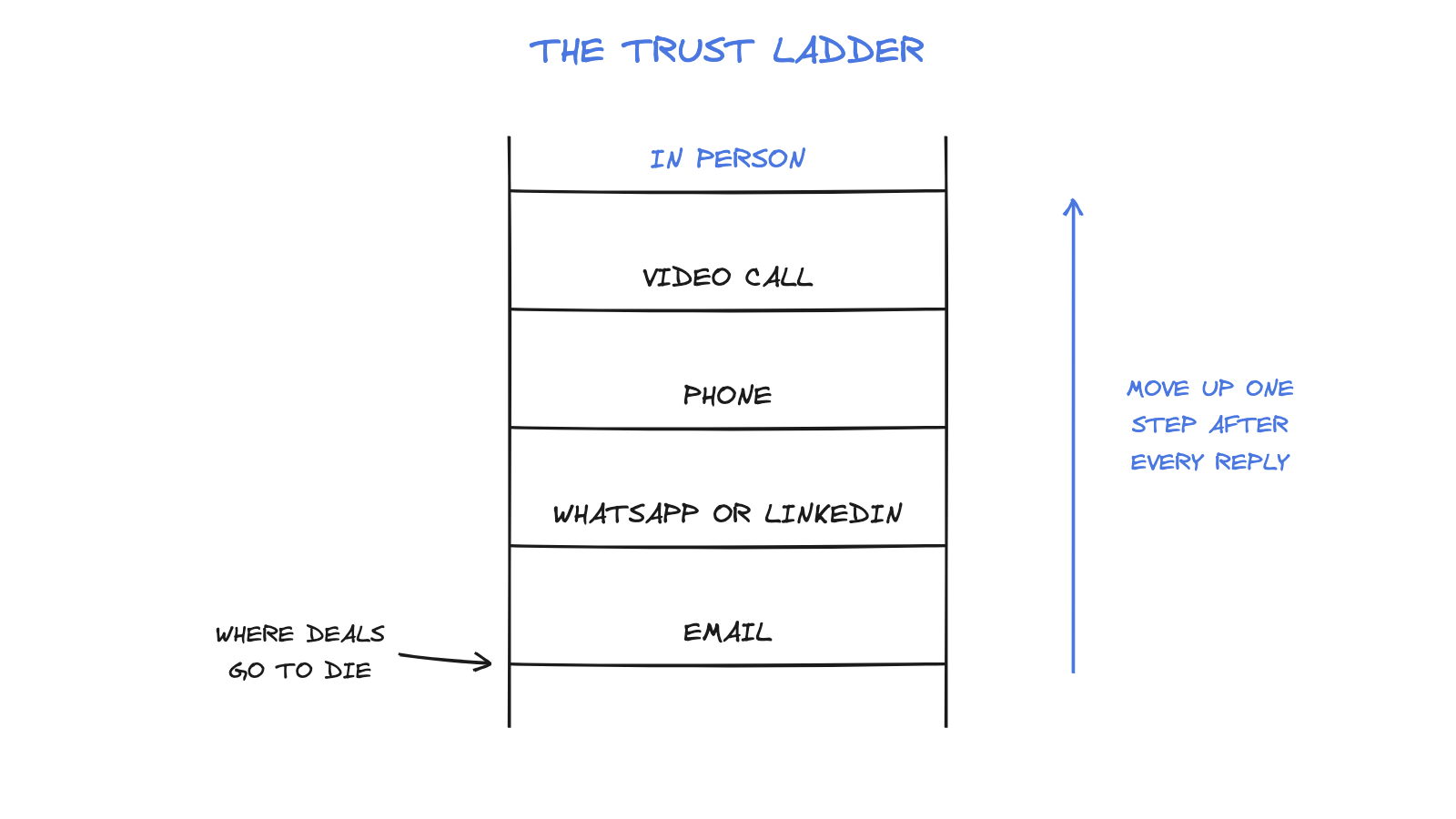
So once a distributor replies, the goal of your reply is to move them one step up that ladder, and keeping the email thread going isn't a step up.
Before you reply, spend five minutes on them. Look at their website, what they sell, who they sell to, and find the sentence in their reply that made it positive. That sentence is what you build the next conversation around.
Then keep the reply short. Answer what they actually asked first, and match the length of what they wrote. A two-line reply deserves a short answer, not a brochure. End with one question, and make it the step up: a quick call, a short video call, or their WhatsApp number. Something like, "Worth a quick call this week, or not really?" Giving them an easy way to say no tends to make yes easier.
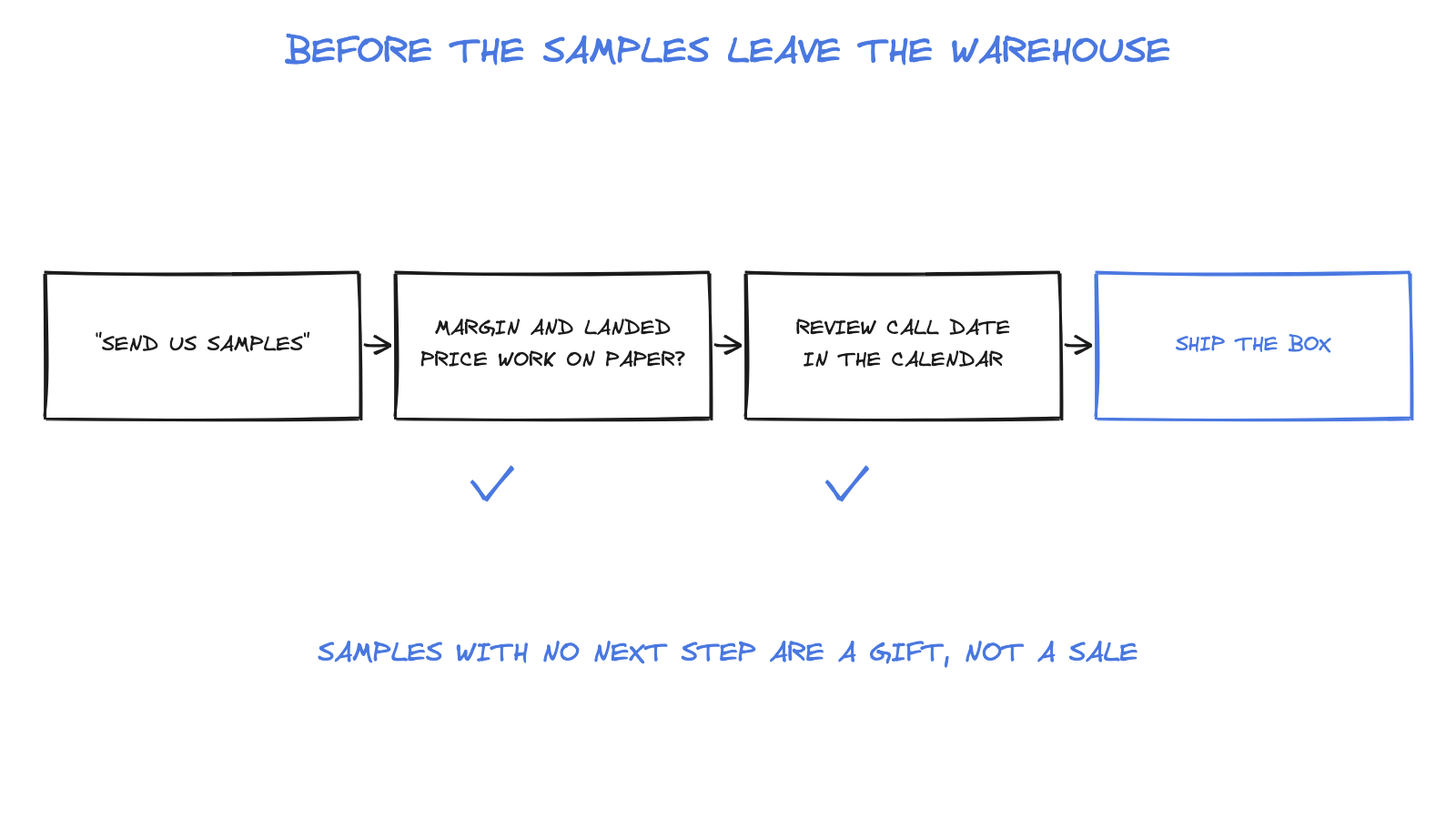
Watch out for samples here. When a distributor says "send us samples", it feels like progress, and often it's where things stall. The samples arrive, sit in someone's office and nobody follows up. Before you send anything, check two things: that the margin and landed price work on paper, and that there's a review call in the calendar. For example: "Sure, I'll send them this week. Once you've had a chance to test them, can we do a 20-minute call with your buyer on the 12th?" Samples with an agreed next step are part of the sales process. Without one, they're often end up being just a gift.
The first call is discovery
When you get them on a call, don't pitch. The first call is about getting to know each other, learning about their business and working out whether they're the right partner. I use the BANT framework to structure it, which for a distributor means four things: can they fund an opening order, who signs off on adding a new line, do their current customers already buy this category, and when do they review new ranges.
Keep in mind, don't talk about yourself too much until they start asking. Until then, it's you asking questions. Which of their customers would buy your product? What did they do the last time they took on a new brand? How would they sell yours? They'll ask about your company when they're interested enough to care, and that's a good sign in itself. I go through the questions I'd ask in more detail in How to Evaluate a Distributor Before Giving Them Your Market.
Before the call ends, agree on the next step while you're both still on the line: a sample test, a call with their buyer, a price discussion.
If you leave it at "let's stay in touch", you're back to email.
And pay attention to what you hear across all of these calls. If good distributors keep raising the same objection, like the opening order being too big or the margin being too thin, a better email won't fix it. The offer needs to change, and I go into how in Why a Good Product Can Be a Bad Business for a Distributor.
If you'd like help working out how to approach the distributors in your market, tell us about your market.
Frequently asked questions
How do you approach a distributor for the first time?
With a short message about them, not about you. Either ask a small question they can answer in a few words, or make a straight offer that says what's in it for them. Leave out the catalogue and company history, and aim to move the conversation to a call as soon as they reply.
Should you send a catalogue in the first email to a distributor?
No. A catalogue in the first email makes the message about you and gives the distributor a job before they've shown any interest. Send it once they've replied and asked about your range.
How many follow-up emails should you send a distributor?
One or two spaced follow-ups, each with a new commercial angle, are usually enough. If those get no reply, switch to LinkedIn, WhatsApp or the phone instead of sending more emails. You can retry that distributor in a few months time.
About the author
Marijan Filipović is a co-founder at Spika, where he helps manufacturers find and sign international distributors. Spika has run distributor acquisition across more than 100 markets on 5 continents, combining direct outbound and inbound campaigns with the qualification and sales process required to move prospects from first conversation to a signed agreement.