How to Write a First Email a Distributor Will Actually Answer
A first email to a distributor works when it's short, about their business, and asks for something they can answer in five words or less. Most manufacturer emails do the opposite. They open with company history, attach a catalogue and ask for a partnership in the first line, which gives the distributor a job before they've shown any interest. The first email has one goal: get a reply. Everything else, the catalogue, the price list, the margin discussion, comes after that. And keep it in proportion. The email is maybe 20% of signing a distributor. A good one gets you a conversation, not an order, and deals still die if you stay in the inbox or send samples with no next step agreed.
This is the detailed version of one step from How to Approach a Distributor About Carrying Your Product. That post covers the whole process, from sizing your market to the first call. Here I'll go through the email itself: the subject line, the first line, the ask, the follow-up, and how to tell what's going wrong when nobody answers.
What a distributor sees when your email lands
Put yourself in a purchasing manager's inbox for a minute. They get supplier emails every day, and most of them look the same: "Partnership opportunity" in the subject, "I hope this email finds you well" in the first line, then a paragraph about a factory they've never heard of. They don't read those. They glance at the subject and the preview line, and decide in a second or two whether it's worth opening.
So the subject line and the first line do most of the work. If those two read like every other supplier email, the rest of it doesn't matter, however good your product is.
The subject line
Write it like one business person writing to another. A few plain words in normal sentence case, nothing that sounds like marketing. "Partnership opportunity", "Quick question" and "Introducing our new range" all look like what they are. What we found works really well, at the time of writing this, is an all-lowercase style. Sure, it isn't all that grammatical or professional but since AI overpolishes everything, the lowercase style comes off more sincere.
A few that work better (illustrations, not templates):
Question on your {category} range
Distribution for {product type} in {country}
New suppliers in {category}
The goal is to look like a normal business email, which it is.
The first line
The first line shows up in the preview, so it either earns the open or it doesn't. A quick test I use: swap your company name for a competitor's. If the email still works, it's about you and not about them.
There are five openers I'd use with distributors, and which one fits depends on how much you know about them. Each example below is an illustration:
The straight offer
Say what you want and what's in it for them, right away, so they can decide in one read. "You could start with one mixed trial pallet of our workshop storage systems instead of a full container, at a {X}% margin." This works well when your offer is genuinely strong, because the right distributors pick themselves out.
The pain question
This is what I call the pencil effect: a small question they'll recognise from the preview alone. "Do your interior design stores ever ask for outdoor lighting under €200 retail?" If the answer is yes, you've started a conversation about their problem, not your product.
Problem sniffing
Use something you found on their website to show a gap. "Your catalogue has five haircare brands, but nothing in heated styling tools." It only works if the gap exists, so do the research first.
The confirmation question
Ask them to confirm something you found, which shows you've looked without pitching anything yet. "Do you still supply independent garden centres across the south?"
The pattern interrupt
Something that breaks the usual supplier pattern while staying commercial. That could be a specific retail gap you spotted in their territory, or a calm disqualifier: "Not sure if your {category} range is already full with {Brand X}, so tell me if this overlaps." Keep it businesslike. Jokes and gimmicks don't land with distributors.
What comes after the first line
Keep the rest short. One line on what's in it for them and one proof point, then the ask. Around 50 to 90 words in total, something you could read out loud in under 20 seconds.
For the "what's in it for them" part, every offer is one of three things. You either help them make money (margin, how fast it sells), save money (a small opening order, low stock risk) or save time (marketing material, product data, someone joining their first customer visits). Pick one per email.
For proof, use something real and specific: a similar distributor in another market, a reorder rate, a retailer group already stocking it. If you don't have that yet, leave proof out rather than writing "industry-leading" or "best-in-class", which a distributor reads as noise.
And it helps to give your offer a shape. "We'd love to explore a partnership" is vague. "A 60-day trial range: three products, one pallet, and we support the display" is something a distributor can actually picture saying yes to.
The ask: something they can answer in five words
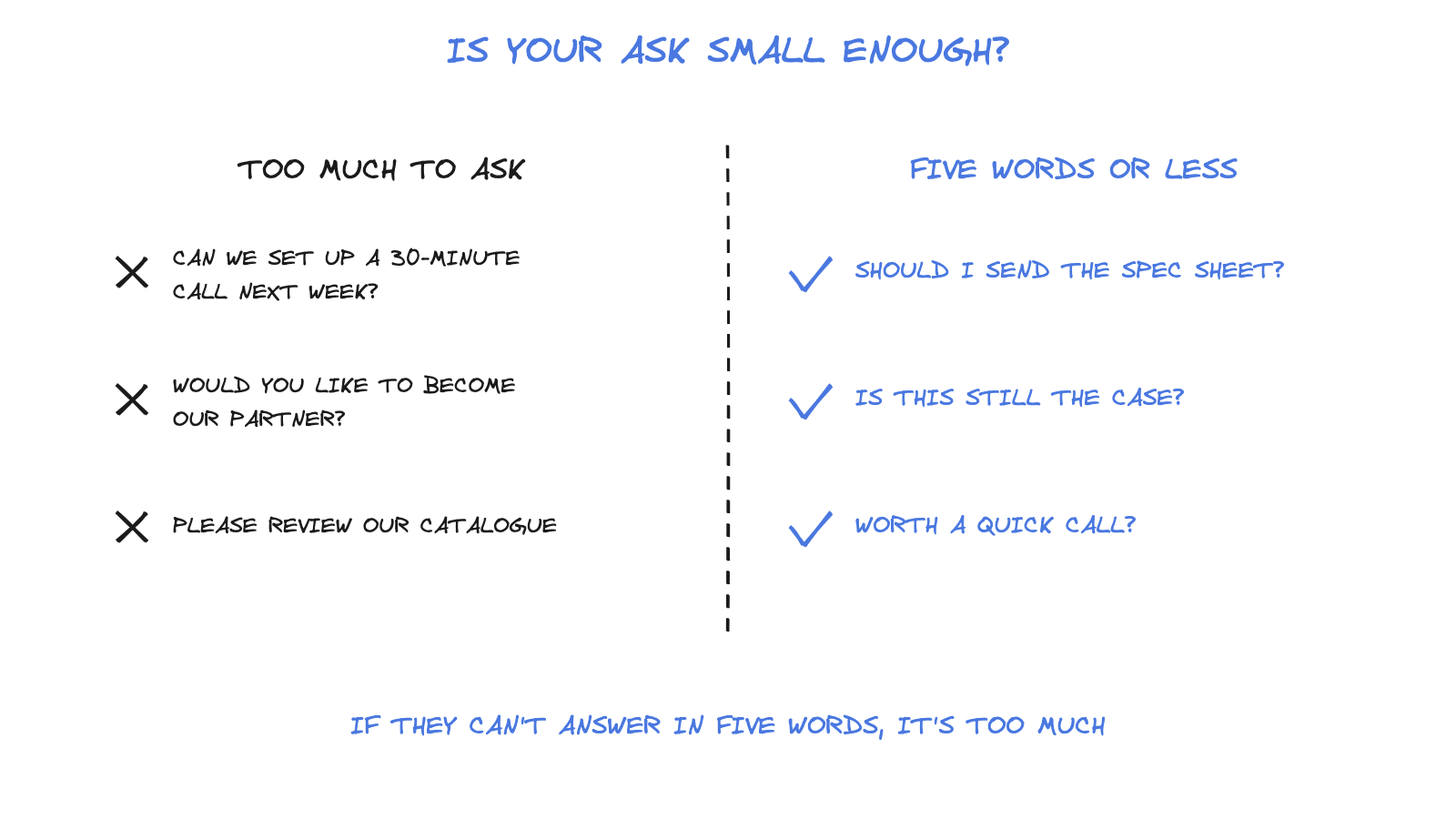
This is where most first emails go wrong. "Can we set up a 30-minute call to discuss a partnership?" is a big ask from someone they've never heard of. If they can't answer your question in five words or less, it's too big.
Asks that pass that test:
"Is this still the case?" (after a confirmation opener)
"Should I send the spec sheet?"
"Reply and I'll send the sell-through numbers from a similar distributor."
"Would love your take on whether this fits your range."
"We put together {category} price points across your competitors. Want it?"
The one call ask I'd use in a first email is a five-minute phone call, framed against the Zoom default: "Everyone's wanted a Zoom call since COVID. Could I just give you a quick call for five minutes and we see if it fits?" A phone call is a step up from email anyway, and getting off email is the whole point, as I explain with the trust ladder in the approach post.
What to leave out
All of these belong to a later conversation, once they've shown interest:
The catalogue or price list attachment
Company history, certificates and "established in..."
The word "partnership" in the subject line
A calendar link
More than one question
And a few openers I'd cut on sight, because every supplier uses them: "I hope this email finds you well", "I wanted to reach out", "We help companies like yours" with nothing behind it, and "Congrats on..." when you don't actually know what you're congratulating them on.
Before and after
Here's the kind of email most distributors get (an illustration, but you've probably received one like it):
Subject: Business cooperation proposal.
Dear Sir or Madam, I hope this email finds you well. We are an ISO-certified producer of industrial fasteners, established in 1994, exporting to 22 countries with a state-of-the-art production plant.
We are looking for reliable partners and would be happy to send you our full product portfolio. Please find our brochure and price list attached.
Best regards.
Everything in it is about the sender, it asks for a partnership in the first message, and it gives the distributor two attachments to read before they know why they should care.
Here's the same manufacturer, rewritten (also an illustration):
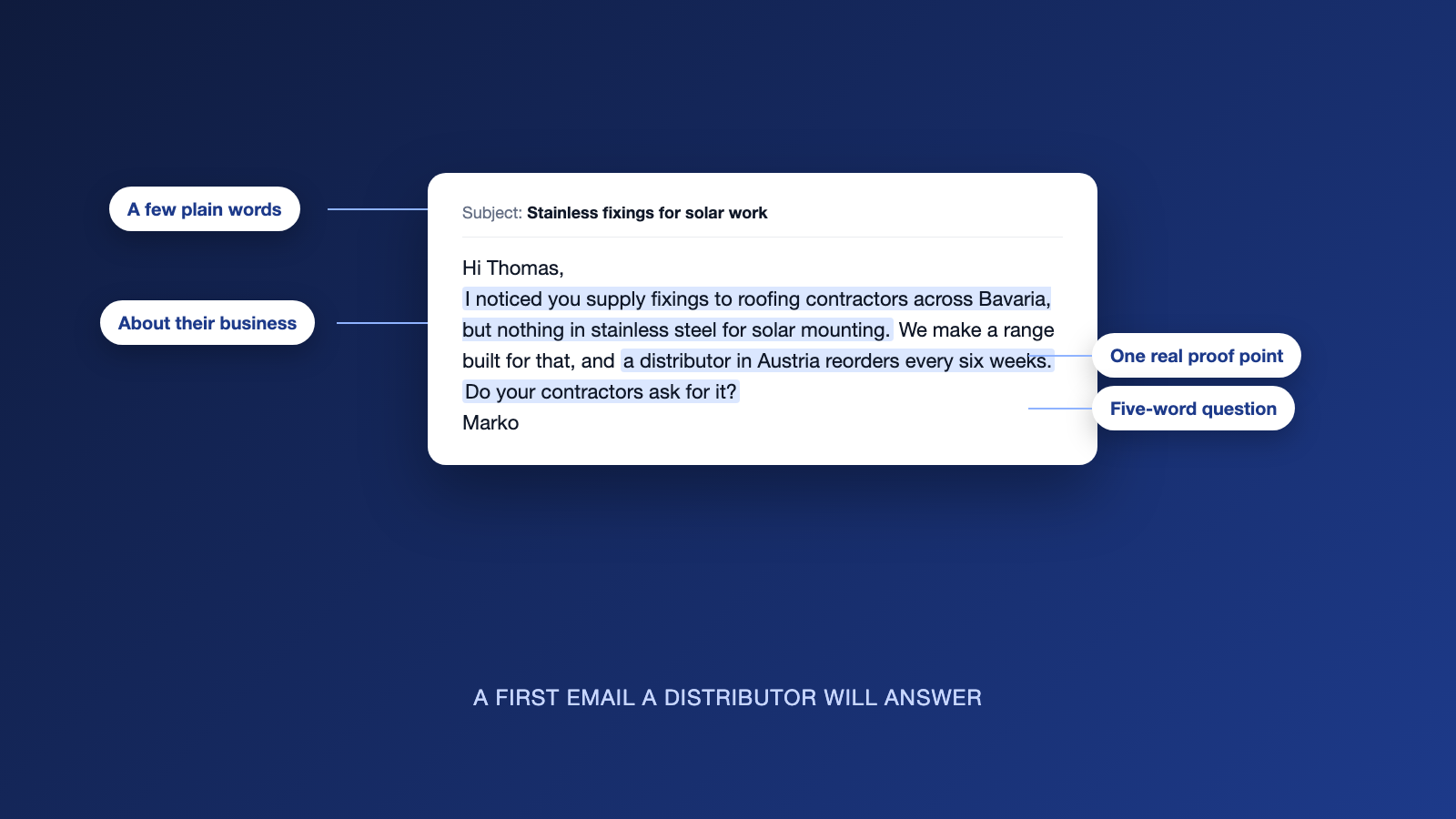
Subject: Stainless fixings for solar work.
Hi Thomas, I noticed you supply fixings to roofing contractors across Bavaria, but nothing in stainless steel for solar mounting.
We make a stainless range built for that, and a distributor in Austria reorders from us every six weeks.
Do your contractors ask for it?
Marko
It's under 50 words, it's about his range and his customers, it has one real proof point and the question can be answered with "yes" or "not really".
The second email
People miss emails, especially distributors who spend whole weeks at shows or visiting suppliers. So send one or two follow-ups, spaced a few days apart, as replies in the same thread.
Each follow-up needs a new angle. If the first email was about margin, the second could be about the small trial order or the support you'd give them. "Just following up", "circling back" and "bumping this" give them nothing new, so they don't get answered either.
Before you give up on a company, try someone else in it. We usually contact about three people per company, for example the owner, the purchasing manager and the category manager, each with an angle that fits their role. The first person might be away or might not be the one who decides, and it's often the second or third who replies.
Three shapes that work for the second email (illustrations):
The whole offer: "From what I've seen, most distributors in {category} are focused on {quick win}. {Problem}. We make {product} that {benefit}. Is {problem} on your radar?"
Ideas: "I was back on your site and had a few ideas on how {product} could fit your range," followed by three short bullets.
Data: three specific facts about their business, one line on what you do, one question.
If a couple of different angles get no reply, another email rarely changes that. Try them on LinkedIn, WhatsApp or by phone instead.
When nobody replies: what to fix first
It's tempting to rewrite the copy when replies don't come. But the copy is usually the last thing to fix. I'd go through it in this order:
The list. Are these actually the right companies, and the right person in each one? If good-fit distributors ignore you entirely, start here.
The offer. If they reply but keep raising the same objection, like the opening order or the margin, a better email won't help. The offer needs to change, which I go into in Why a Good Product Can Be a Bad Business for a Distributor.
The subject line and the first line.
The ask, then the timing and the number of follow-ups.
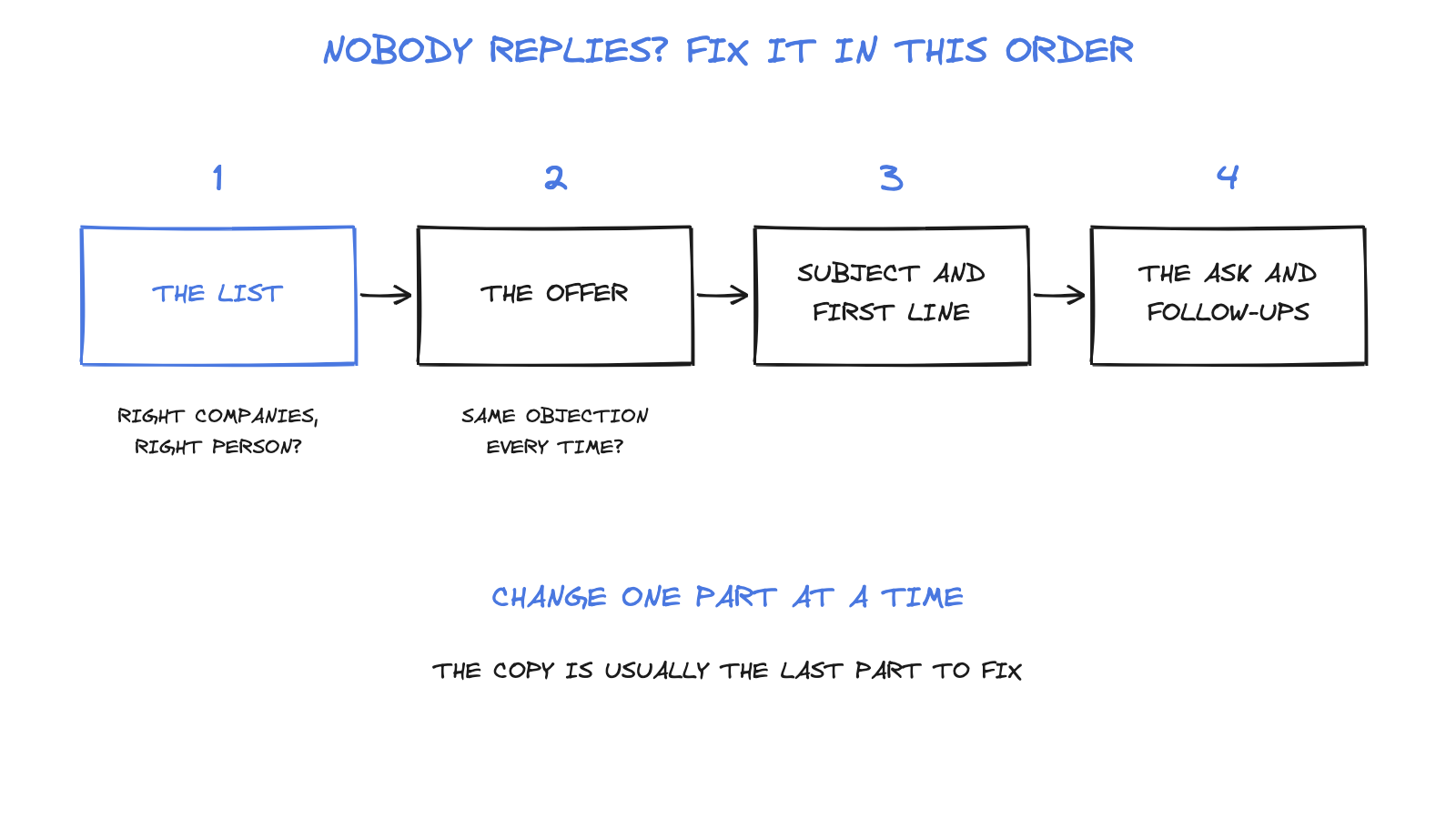
Change one thing at a time. If you change the list, the copy and the offer all at once and replies go up, you won't know which one did it.
On a big list, keep two numbers apart: total replies and interested replies. At volume, about one interested lead per 100 companies contacted is normal. Total replies, including useful ones like "no, we already carry Brand X", should be several times higher. If almost nobody even replies to say no after 200 or more emails, the problem is usually deliverability or the list, so fix that before you test different angles. On a small list of a few hundred companies, you can't test your way to a better email at all, because you'll run out of companies before the results mean anything. There you research each one and get it right the first time, which I explain in the approach post.
And remember what the email is for. It buys you a five-minute conversation, and from there the work is moving them up the trust ladder and checking whether they're the right partner, which I cover in How to Evaluate a Distributor Before Giving Them Your Market. A great email can't fix an offer that doesn't make sense for the distributor.
If you'd like help working out how to approach the distributors in your market, tell us about your market.
Frequently asked questions
How long should an email to a distributor be?
Around 50 to 90 words. Short enough to read in under 20 seconds, with one point about their business, one proof point and one small question.
What should the subject line of an email to a distributor be?
A few plain words in normal sentence case, the way one business person writes to another, like "Question on your {category} range". Avoid "partnership opportunity" and anything that sounds like marketing.
Should you attach a catalogue to the first email to a distributor?
No. Send it once they've replied and asked about your range. In the first email it makes the message about you and gives them reading to do before they're interested.
About the author
Marijan Filipović is a co-founder at Spika, where he helps manufacturers find and sign international distributors. Spika has run distributor acquisition across more than 100 markets on 5 continents, combining direct outbound and inbound campaigns with the qualification and sales process required to move prospects from first conversation to a signed agreement.