How to Grow Your Distributor Network by Starting With Your Best Partner
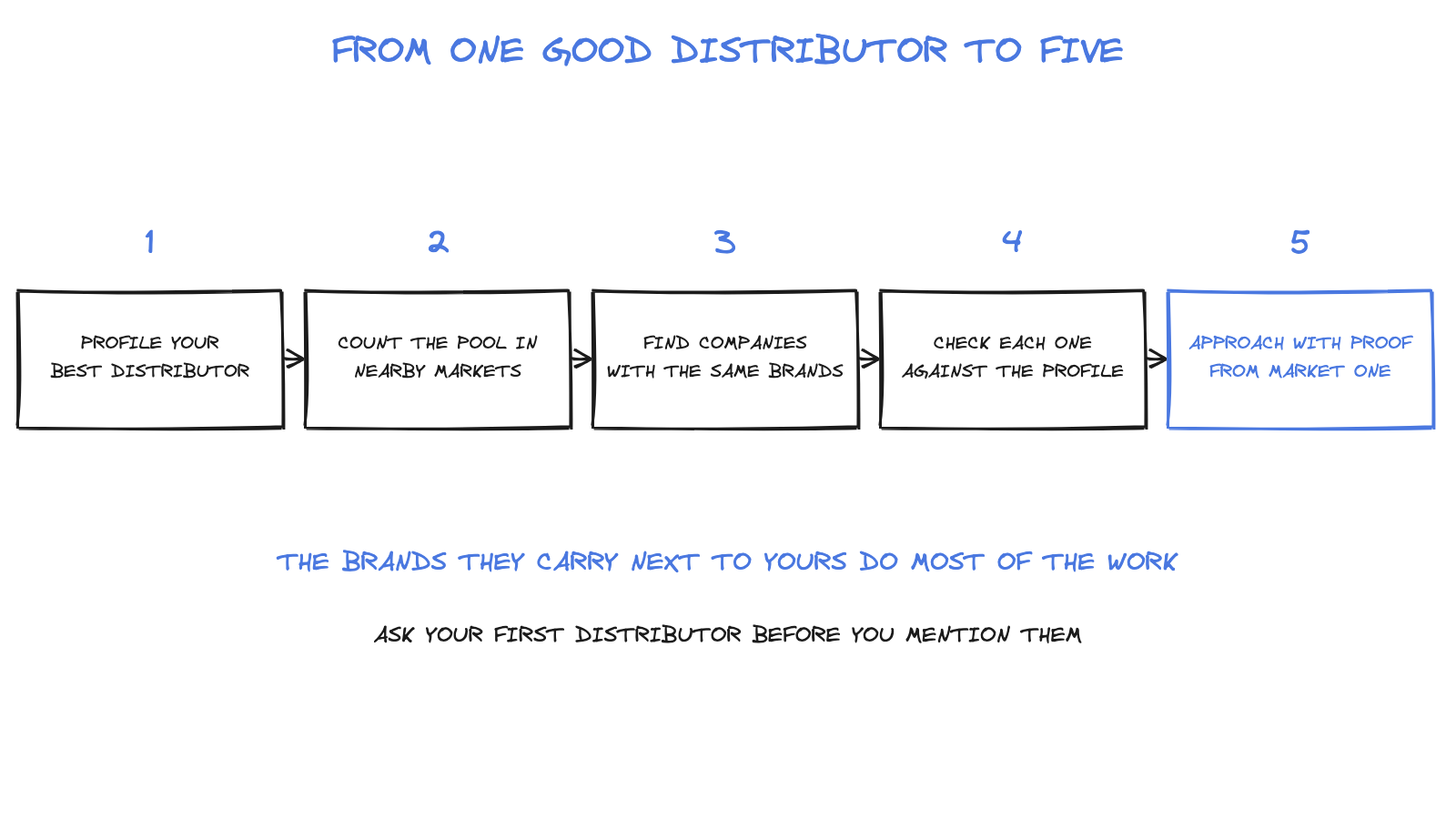
You don't need to find five new distributors from scratch. You need to turn one good distributor into five. The quickest way to find your next distributors is to copy the one that's already working. Write down all the things that make your best distributor good, find companies that match that profile in desired markets, and approach them with proof from the first market. You shouldn't be guessing what a good partner looks like. You already know who they have to be.
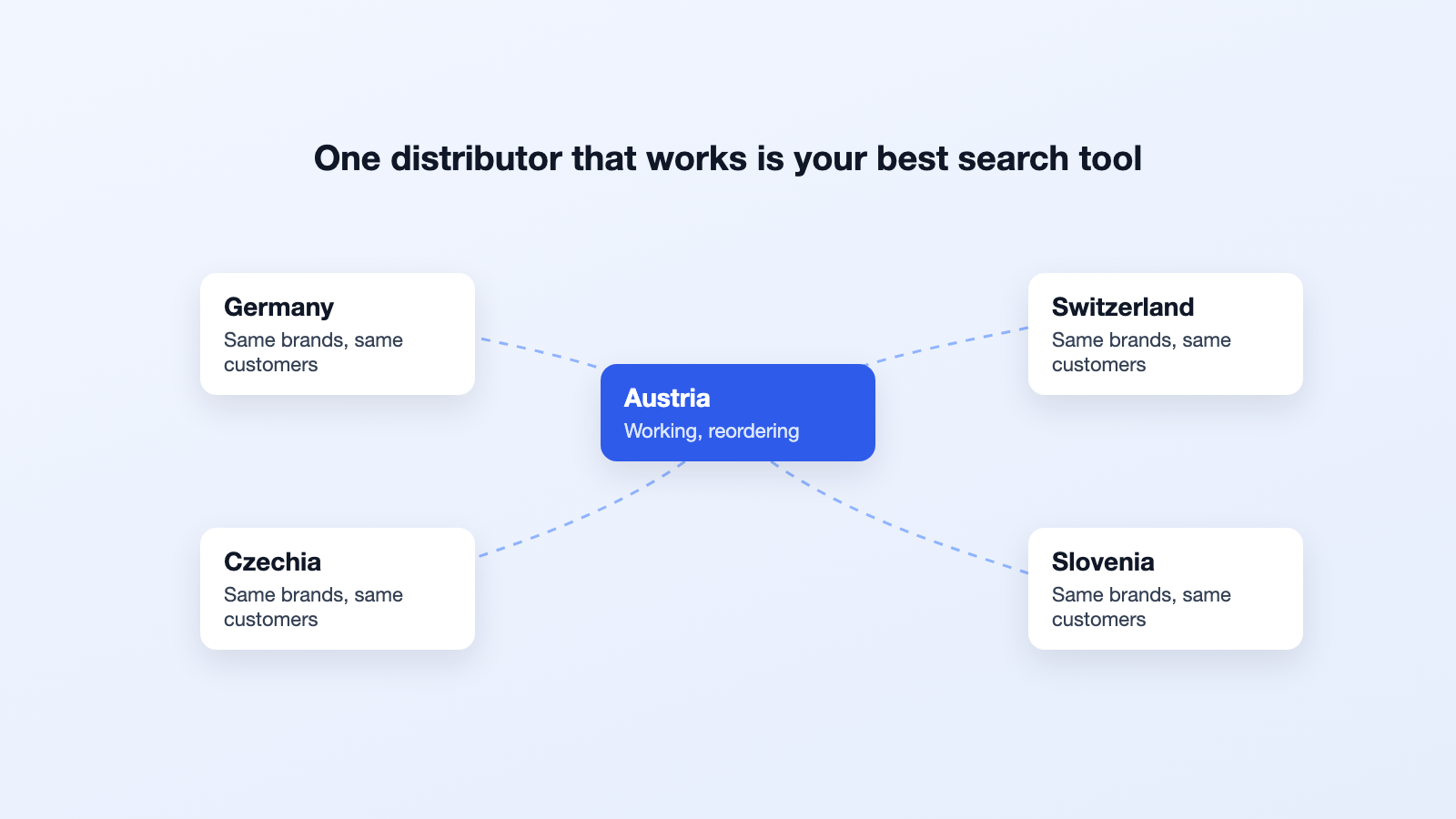
Let's assume that you signed a distributor in Austria a year ago and it's going well. They reorder frequently, their reps actually bring your product up on visits and showcase it, and customers ask for it by name. Now you want to get Germany, Switzerland and Czechia as well. Most suppliers start again from zero at this point: they search "[product] distributor Germany", get a list of companies that call themselves distributors, and send whoever comes up a generic block of AI slop with 5 links.
But you already know more than that. You know what kind of company sells your product well, what their sales team should look like, who its customers are, and which brands sit next to yours in its catalogue. This should be the starting point of your search.
Step 1: Write down why your best distributor works
Before you look anywhere, put the profile on paper. Most of this you can get from their website and one candid call with them:
What they sold before you came along, and which brands
Who they sell to: the type of customer, roughly how big, and in which regions
How they sell: their own sales reps, a showroom, a webshop, installers or a mix
How big they are: employees, number of reps, how much of the country they actually cover
Why they said yes: what in your offer mattered to them
How they launched you: what they did in the first months that worked
The most useful line on that list is usually the brands they carry next to yours. Companies that carry the same complementary brands tend to sell to the same customers, in the same way. That one detail will do a lot of the searching for you in Step 3.
And ask your distributor directly why they think it's working. They'll often tell you things you'd never see from the outside, like which customer type took to it first or which objection kept coming up.
Step 2: Decide where to look first
Start with the markets closest to your first one: similar customers, a similar way of buying, ideally a shared language or a border. Then get a rough sense of how many companies of that type there are in each.
In Europe, Eurostat publishes the number of wholesale businesses per country by category. In the US, the Census Bureau's County Business Patterns gives you the number of wholesale businesses by industry code down to state and county level. If you don't know which code fits, ask ChatGPT or Claude for the NAICS codes that cover wholesalers of your product. The two sources count different things, though. Eurostat counts enterprises, while County Business Patterns counts establishments with paid employees, so one company with several branches can show up more than once. Neither matches your product exactly, and neither counts qualified partners, so don't compare countries directly with them. What they do show you is whether you're dealing with dozens of possible partners or thousands, which I explain in more detail in How Much Does It Actually Cost to Find Distributors?
Pick two or three markets to start with, not ten. You'll want to support the new partners properly, the way you built up the first one.
Step 3: Build the lookalike list
This is where most of the work is. I'd come at it from three directions.
Search for the same type of company
Use Google Maps in the local language, with the local word for the kind of company you want: Großhandel, hurtownia, grossiste, distribuidor, or the American "supply", "wholesale" or "dealer". Add the customer type too, like "salon supply" or "agricultural machinery dealer". Then use Apollo or LinkedIn Sales Navigator to filter companies by industry, country and a headcount range close to your winner's, and to find the people in purchasing or category management.
For company details, business registers help a lot in Europe: North Data covers Germany, Austria, Switzerland and several other countries, and the UK has Companies House. In the US, registries are split by state and say less, so you'll rely more on LinkedIn and the company's own website.
Follow the brands your winner carries
This is the shortcut. Take the three to five complementary brands your best distributor carries and find out who sells those brands in the new market. Many brands have a "where to buy" or dealer locator page, filterable by country, state or ZIP code. If they don't, search Google for the brand name plus the local word for dealer, like "[Brand] Händler", "[Brand] revendeur" or "[Brand] dealer Ohio".
Companies that already stock the same brands as your winner are worth shortlisting, because they often sell to similar customers and already know how to handle that kind of product. However, it's a lead, not concrete proof, so check their customer mix, the territory they actually cover and whether they can service your product before you treat them as a fit.
And check your competitors' dealer pages too. A company that lists a direct competitor may well be committed to them, though a listing doesn't prove an exclusive deal, so ask. And a region where no competitor has a dealer is worth a closer look, but an empty spot on the map might also mean there's no demand there.
Use AI to sort the list, not to build it
ChatGPT or Claude is useful once you have a list. Paste in a company's homepage or "about" page and ask it who they sell to, which brands they carry and whether they fit your profile. That saves a lot of reading. What I wouldn't do is ask it to "list distributors of X in Germany". It tends to give you outdated or made-up companies, so check every answer against the company's own website before you contact anyone. And either way it wouldn't give you the full list.
This is the part we automate for clients. We automate part of the research across public listings, company websites and dealer directories, then verify the shortlist by hand. But you can do a smaller version of the same thing by hand, and for a first list of 50 to 100 companies, the manual way works fine.
Step 4: Check every company against the profile
Now go through the list and score each company against your winner's profile. Do they sell to the same customers? Do they carry complementary brands? Do they carry a direct competitor? Are they a similar size, with their own reps? You'll need to make your own criteria and then put the strong fits in an A list and research those properly before you write a word. I go through what to look for in How to Evaluate a Distributor Before Giving Them Your Market.
Don't skip this because the list "looks right". A company can carry the right brands and still be the wrong partner, for example a retailer with a wholesale page, or a distributor so big that you'd be one line among hundreds.
Step 5: Approach them with proof from your first market
This is where having one good distributor really pays off. Your first message isn't a cold pitch anymore, it's "a company like yours is already doing this next door". Something like (treat this as an illustration, not a template):
"We work with a distributor in Austria that sells to the same kind of {customer} you do, alongside {brand they also carry}. Is {category} something your customers ask about?"
Get your first distributor's permission before you mention them or anything about their results. Most are fine with a general description, but sales figures are theirs to share, not yours.
And ask your winner for introductions. Distributors often know their counterparts in neighbouring countries from trade shows and supplier meetings, and as long as they don't compete, an introduction from them is worth more than any email you write. For the outreach itself, I go through the first message in How to Write a First Email a Distributor Will Actually Answer and the rest of the process in How to Approach a Distributor About Carrying Your Product.
What changes between Europe and the US
Europe | United States | |
Gauging the pool | Eurostat counts enterprises per country and category | County Business Patterns counts establishments with paid employees, so one company can appear as several locations |
Company details | Business registers like North Data and Companies House | State registries say less, so lean on LinkedIn and company websites |
How to search | Country by country, in the local language | One language, but region by region |
Import records | Public intra-EU trade statistics can help size a market, but they don't give you a list of named importers to contact | Shipment databases like ImportGenius or Panjiva can help identify importers where records are available |
How distribution is set up | Often national or regional distributors per country | Often regional dealers, plus independent sales reps |
The biggest practical difference is language. In Europe you're searching country by country, in the local language, and a German search won't find you an Austrian wholesaler that describes itself differently. In the US you're working in one language, but across very different regions, and a lot of distribution runs through regional dealers and independent reps rather than one national company.
If you'd like help finding lookalikes for your best distributor in a new market, tell us about your market.
Frequently asked questions
How do I find more distributors like the one I already have?
Write down your best distributor's profile: what they sell, who they sell to, how big they are and which brands they carry next to yours. Then find companies in nearby markets that match it, starting with the companies that stock the same complementary brands, and approach them with proof from your first market.
Can I use ChatGPT to find distributors?
It's useful for sorting and summarising a list you've already built, for example reading a company's website and telling you who they sell to. I wouldn't use it to generate the list itself, because it often returns outdated or invented companies. Check everything against the company's own website.
Should I ask my current distributor for introductions?
Yes, as long as the companies don't compete with them. Distributors often know their counterparts in neighbouring countries, and an introduction from a partner who already sells your product carries a lot of weight. Ask before you mention them or their results to anyone.
About the author
Marijan Filipović is a co-founder at Spika, where he helps manufacturers find and sign international distributors. Spika has run distributor acquisition across more than 100 markets on 5 continents, combining direct outbound and inbound campaigns with the qualification and sales process required to move prospects from first conversation to a signed agreement.
Sources
Eurostat. Enterprises by detailed NACE Rev. 2 activity and special aggregates (dataset sbs_ovw_act), number of enterprises in wholesale trade, accessed 25 November 2026. (Eurostat data browser)
U.S. Census Bureau. County Business Patterns: About the program (annual statistics for establishments with paid employees, by industry and geography). Census.gov blocks some visitors, so this is an archived copy from October 2026. (archived page)